
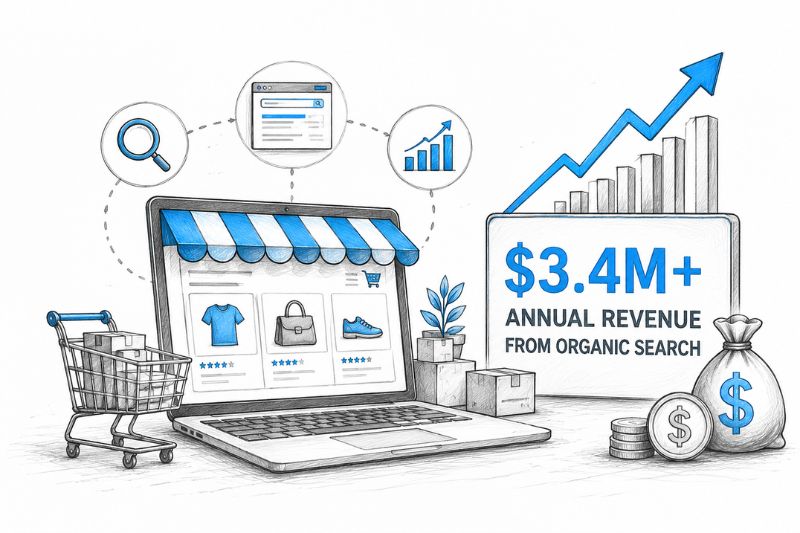
Most ecommerce brands assume they need massive advertising budgets to compete with industry giants. But what if the real opportunity lies elsewhere?
In this case study, we’ll break down how an ecommerce business investing just $3,500 per month in SEO generated more than $3.4 million in annual revenue from organic search. Along the way, they grew their organic visibility, outranked major competitors, and even beat Amazon for some of their most valuable search terms.
More importantly, we’ll show you exactly what drove those results and what lessons other ecommerce businesses can take from this approach.
Key Takeaway
- This ecommerce brand generated more than $3.4 million in annual organic revenue by focusing on high-impact SEO activities, including optimizing revenue-driving category pages, building strategic backlinks, and targeting untapped keyword opportunities.
- The case study proves that ecommerce businesses do not need enterprise-level budgets to compete. With a focused strategy and consistent execution, SEO can become a long-term growth asset that drives both revenue and business value.
The Results: From Invisible to Millions in Revenue
When the campaign began in 2021, the client was attracting around 83,000 organic visitors per month. They had room to grow, but they weren’t dominating their market.
Fast forward a few years, and the picture looked very different.
The business was generating more than 150,000 organic visitors each month. According to Google Analytics, the company generated more than $26 million in annual revenue, with over 13% of that, approximately $3.4 million, coming directly from organic search.
Even more impressive, the majority of this traffic was non-branded.
That means these visitors weren’t searching for the company’s name because they already knew the brand. They were discovering the business through high-intent searches for products they actively wanted to buy.
This distinction matters because non-branded traffic represents new customer acquisition. It’s one of the clearest indicators that SEO is driving meaningful business growth rather than simply capturing existing demand.
Step 1: Determine Whether SEO Is Actually Worth It
One of the biggest mistakes businesses make is assuming SEO is the right channel for everyone.
It isn’t.
Before investing heavily in any campaign, we believe it’s essential to determine whether SEO can realistically generate a return. Not every ecommerce niche has enough search demand, and in some cases, businesses may achieve better results through other channels.
The first step is understanding whether people are actually searching for the products you sell.
For example, if you’re selling protein powder, search demand is obvious. Hundreds of thousands of people search for terms related to protein supplements every month. That demand creates opportunity.
Once you’ve established demand, the next step is evaluating who’s currently winning.
Who ranks at the top of Google?
How much traffic are they generating?
What level of authority do they have?
If competitors are consistently attracting substantial organic traffic, it’s often a strong signal that SEO can work within that market.
Estimating Revenue Potential
After identifying demand, it’s possible to estimate the financial opportunity.
Using conservative assumptions, you can calculate potential revenue by considering:
- Monthly search demand
- Expected click-through opportunities
- Industry-average conversion rates
- Average order value
Even rough calculations can reveal whether SEO has the potential to become a major revenue driver.
Beyond revenue, SEO can also increase the value of the business itself.
Companies with diversified acquisition channels tend to be more attractive to potential buyers. A business generating predictable revenue through organic search is often viewed as less risky than one relying exclusively on paid advertising.
Step 2: Identify the Gaps That Matter Most
SEO isn’t about doing everything.
If you’re competing against massive brands, trying to replicate every tactic they’ve ever used isn’t realistic.
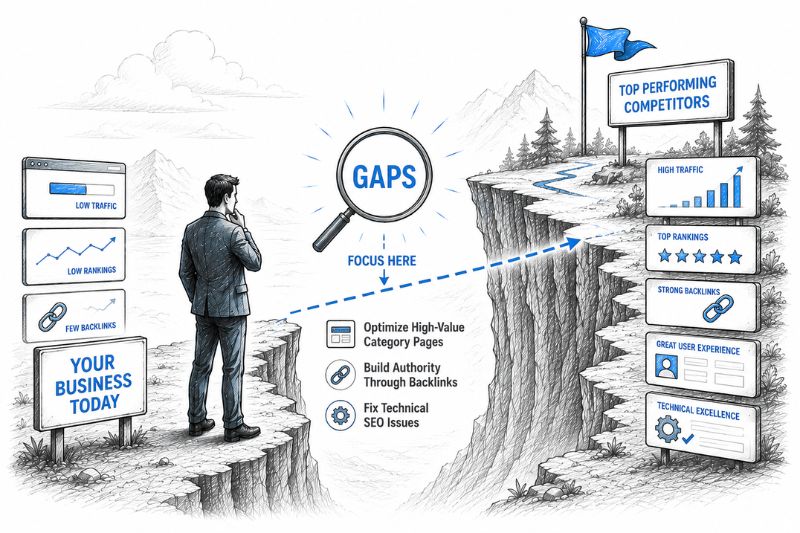
Instead, the goal is to identify the gaps between where your business is today and what top-performing competitors are doing differently.
For this particular client, the analysis revealed three priorities:
- Optimizing category pages targeting valuable keywords.
- Building authority through backlinks.
- Resolving technical issues that could limit performance.
Technical SEO mattered, but it wasn’t the primary growth driver.
The vast majority of effort went toward the activities most likely to move the needle.
This 80/20 mindset shaped the entire campaign.
Rather than spreading resources thin, the strategy focused on the actions most closely tied to revenue growth.
Step 3: Optimize the Pages That Generate Revenue
For most ecommerce businesses, category pages represent the biggest SEO opportunity.
These pages align closely with buyer intent because users searching for broad product categories are often ready to purchase.
If someone searches for “men’s tank tops,” they don’t want a blog post explaining what tank tops are.
They want options they can buy.
That’s why optimizing category pages became a major focus of this campaign.
Businesses should identify the categories with the greatest commercial potential and ensure those pages are fully optimized to compete in search results.
Create New Category Pages for Quick Wins
One of the fastest ways to generate early results is identifying searches that competitors have overlooked.
Using keyword research, it’s often possible to uncover lower-competition variations that still demonstrate strong buying intent.
For example, instead of targeting an ultra-competitive keyword like “workout sets,” opportunities might exist around terms such as:
- Cute workout sets
- Matching workout sets
- Seamless workout sets
- Plus-size workout sets
Each of these terms can justify its own dedicated category page.
Because competition is often lower, these pages can generate results more quickly while building momentum for larger initiatives.
Early wins help prove ROI and create confidence in the broader strategy.
More importantly, the revenue generated can be reinvested into increasingly competitive opportunities over time.
Step 4: Strengthen Your Site Structure
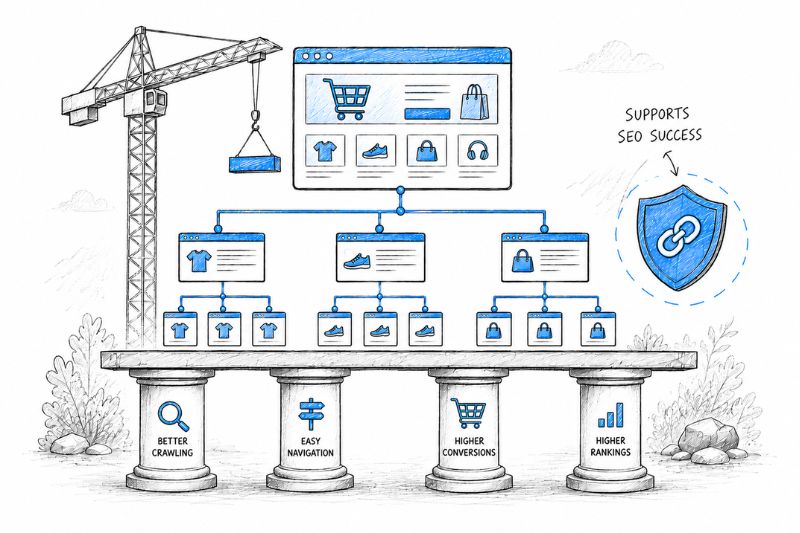
Site structure doesn’t usually get the same attention as backlinks or content, but it plays an important supporting role in ecommerce SEO.
The principle is simple. Your most important pages should also be the easiest for users and search engines to find.
That means featuring your highest-priority category pages prominently within your main navigation.
If a product category is critical to your business, don’t bury it several clicks deep in your website architecture.
Your homepage can also help reinforce these priorities. Since it’s typically the strongest page on your site from an authority perspective, linking to key categories directly from the homepage can send stronger signals about their importance.
These adjustments may seem small, but they help search engines understand which pages deserve the most attention.
Step 5: Build Authority Where It Matters Most
For this client, backlinks ultimately became the biggest driver of growth.
After identifying and optimizing the right category pages, the next challenge was building enough authority to outrank established competitors.
Many businesses make the mistake of directing all of their backlinks to the homepage.
The problem is that when you’re competing against companies like Amazon, that’s an almost impossible battle to win.
Amazon’s homepage authority is enormous.
Instead, the strategy focused on building high-quality backlinks directly to category pages.
This approach allowed the client to strengthen the pages tied directly to revenue-generating keywords without needing to match Amazon’s overall authority.
By concentrating authority where it mattered most, they were able to compete far more effectively.
The goal wasn’t to beat Amazon everywhere.
It was to beat Amazon where it counted.
Step 6: Solve Seasonal Revenue Gaps
Many ecommerce businesses experience seasonal fluctuations.
Sales spike during peak periods and decline dramatically during slower months.
Rather than accepting these downturns as unavoidable, this client used SEO to smooth out demand throughout the year.
The strategy involved identifying complementary products with strong search demand and relatively low competition.
By expanding into categories that performed well outside of their traditional peak season, they created additional revenue streams that helped stabilize the business.
Keyword research wasn’t just used to rank existing products.
It also helped shape product expansion decisions.
The Numbers: SEO Investment vs Revenue Generated
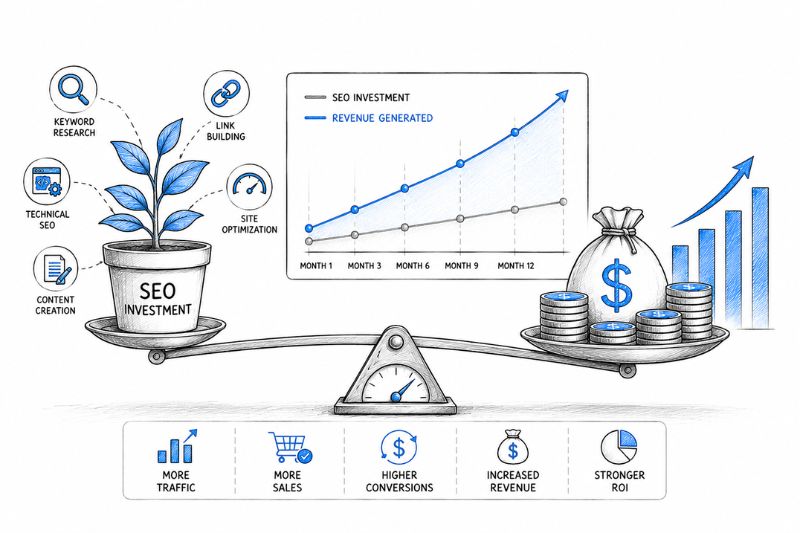
Over the course of the engagement, the client invested approximately $169,800 into SEO.
At first glance, that figure may sound substantial.
But context matters.
The campaign ran for nearly five years, beginning with monthly investments closer to $1,000 to $1,200 before eventually increasing to approximately $3,500 per month.
During that same period, organic search generated more than $8 million in cumulative revenue.
The relationship between investment and return became increasingly clear over time.
As SEO began producing profitable results, the business reinvested those gains into additional marketing channels.
Organic search became the engine that funded broader growth initiatives.
The business was able to increase spending on paid advertising, experiment with influencers, and expand its marketing efforts because SEO had already proven itself as a profitable acquisition channel.
The Impact on Company Value
The value created extended beyond revenue alone.
Using standard ecommerce valuation multiples, the business also experienced a significant increase in enterprise value.
The combination of recurring organic revenue, improved profitability, and diversified customer acquisition channels made the company more attractive from an acquisition perspective.
The estimated increase in company value exceeded $7 million.
Combined with the profits generated through organic search, the overall value created through SEO reached well into eight figures.
Why SEO Continues Paying Off
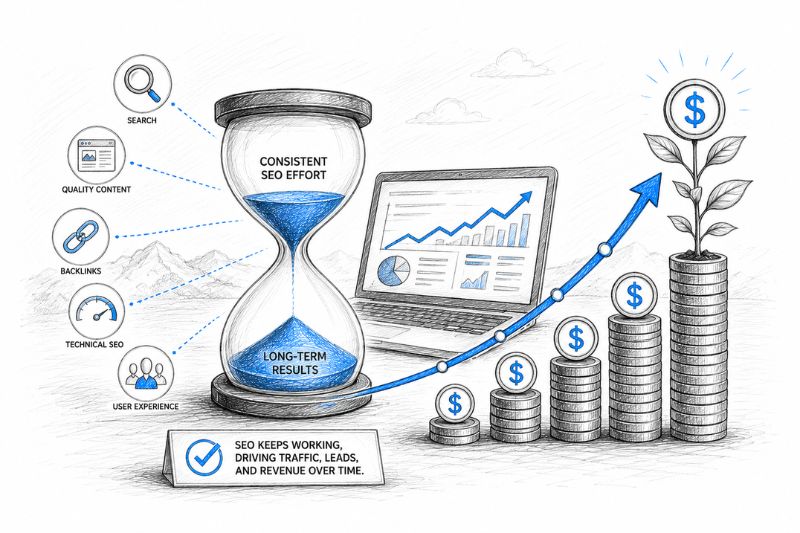
One of SEO’s biggest disadvantages is that it takes time.
New ecommerce businesses often need several months before meaningful results begin to appear. Even established brands should expect a period of investment before seeing significant returns.
This delayed gratification causes many businesses to quit too early.
But it’s also what creates SEO’s biggest advantage.
Paid advertising stops producing results the moment you stop spending.
SEO doesn’t.
Based on this agency’s experience, businesses that pause SEO efforts often continue benefiting from previous work for months afterward.
Growth may slow, plateau, and eventually decline over time, but the value generated doesn’t disappear overnight.
That’s why SEO behaves less like a marketing expense and more like building an asset.
You’re creating something that continues working long after the initial investment.
The Biggest Lessons From This Case Study
Focus on the Highest-Impact Opportunities
SEO isn’t about checking every box on an endless list of tactics.
The businesses that succeed identify the few activities most likely to drive results and execute them exceptionally well.
For this client, the winning formula was clear:
- Address critical technical issues.
- Optimize category pages.
- Build authority strategically.
Trying to do everything at once often leads to wasted resources and slower progress.
Category Pages Are Often Where the Money Is
For ecommerce businesses, category pages frequently represent the highest-value SEO assets.
These pages target commercial searches from users actively evaluating products.
When properly optimized and supported with authority, they can become major revenue drivers.
If you’re not prioritizing your category pages, there’s a good chance you’re leaving significant opportunities on the table.
SEO Rewards Patience
Many businesses abandon SEO after four or five months because they haven’t seen dramatic improvements.
Unfortunately, this often happens just before momentum begins to build.
The brands that achieve exceptional results are usually the ones willing to stay committed long enough for compounding effects to take hold.
Consistency matters.
You Don’t Need to Be the Biggest Brand
Perhaps the most encouraging lesson from this case study is that smaller businesses can compete against much larger players.
You don’t need Amazon’s budget.
You don’t need their team size.
You need a focused strategy, disciplined execution, and a clear understanding of where your opportunities lie.
The right approach can help businesses outperform competitors that appear untouchable.
Not Every Ecommerce Store Should Invest in SEO
Finally, it’s important to acknowledge that SEO isn’t the right fit for every business.
Some niches simply don’t have enough search demand.
Others may be so competitive that alternative channels provide a stronger return.
Before investing heavily, businesses should understand the size of the opportunity available to them.
Making that assessment upfront can save significant time, money, and frustration.
Final Thoughts
This case study demonstrates that sustainable ecommerce growth rarely comes from chasing every tactic at once.
Instead, it comes from identifying the opportunities with the greatest potential, executing consistently, and giving the strategy enough time to work.
This client didn’t outspend Amazon.
They didn’t have unlimited resources.
What they did have was a clear understanding of where the biggest opportunities existed and the discipline to focus on them over the long term.
The result was more than $3.4 million in annual organic revenue, over $8 million generated throughout the engagement, and millions of dollars in additional business value.
SEO isn’t always the fastest marketing channel.
But for the right businesses, it can become one of the most profitable and defensible growth assets they ever build.
Ready to Find Your Biggest SEO Opportunities?
At Batlinks, we help businesses uncover the SEO opportunities that actually drive revenue. Whether you’re trying to increase organic visibility, outrank larger competitors, or determine whether SEO is the right investment for your business, our team can help you build a strategy grounded in data and focused on long-term growth.
If you’re ready to discover what’s possible for your business, get in touch with Batlinks today and let’s start building an SEO strategy that delivers measurable results.
Frequently Asked Questions
How long does it take for ecommerce SEO to show results?
Most ecommerce businesses start seeing meaningful SEO progress within 3 to 6 months. The exact timeline depends on factors such as competition, website authority, and the resources invested, but the strongest results often come from sustained efforts over 12 months or longer.
Is SEO worth it for ecommerce businesses?
Yes, SEO can be one of the highest-return marketing channels for ecommerce businesses. Unlike paid advertising, organic traffic can continue generating revenue long after the initial investment, making SEO a valuable long-term asset for the right business.
What pages should ecommerce stores prioritize for SEO?
Category pages are often the most important pages to optimize. They typically target high-intent searches from shoppers who are actively comparing products and are closer to making a purchase decision.
Can small ecommerce brands compete with Amazon in search results?
Yes, smaller brands can outperform larger competitors for targeted keywords. By focusing on niche opportunities, optimizing the right pages, and building authority strategically, businesses can win valuable rankings without matching enterprise-level budgets.