
If you run a family law practice and want SEO to start producing results faster, there is a practical way to approach it.
A lot of law firms make the mistake of going straight after the biggest, most competitive keywords in their city, only to get discouraged when nothing happens quickly. The reality is that SEO can work, even if you are starting from almost zero and your competitors are already far ahead. You just need the right strategy.
See who’s winning Google & AI search in your city
I or my colleague will record a free 3–7 minute personalised video showing who ranks #1 for family law in your market — and roughly how many consultations that position earns them every month.
In this article, we will walk through the fastest way to start seeing SEO traction for a family law firm, especially if you are in a competitive market. We will cover how long-tail keywords can help you get momentum, what types of pages to create, and how to turn that traffic into actual cases.
Understanding the Competitive Landscape
If you are just starting out, or your competitors are way ahead of you, ranking for terms like “divorce lawyer” or “family law attorney” in your city can be extremely difficult.
Let’s say you are in Los Angeles. Los Angeles has millions of people and thousands of law firms, many of which have already invested heavily in SEO. Some of your competitors may have spent hundreds of thousands of dollars over the years building up their rankings.
So what should you do in that situation?
Should you give up on SEO and focus only on other channels?
The answer is no.
This is actually a common situation. Many law firms come in with little to no SEO history. They are starting from scratch while competing against firms that have been investing in SEO for years. That does not mean SEO is off the table. It just means you need a smarter way to enter the market.
The Best Strategy: Go After Both Main Keywords and Long-Tail Keywords
The best approach is to focus on both of these at the same time:
- Your main target keyword, like “divorce lawyer” or “family law attorney” in your city
- Longer-tail keywords that are easier to rank for and can bring in leads sooner
You should absolutely keep your eyes on the big rankings. It makes sense to want the number one position for the main service keyword in your city. But most of your immediate effort should go toward long-tail keywords, because that is where you can start getting traction faster.
This is how you get the SEO snowball rolling.
It gives you proof that SEO is working. It helps you generate leads earlier. It gives you confidence to keep investing. And it avoids the common mistake of putting a small budget into highly competitive keywords, seeing no results, and deciding SEO does not work.
That happens all the time. A law firm spends a few thousand dollars, publishes a few blog posts, gets a few backlinks, sees very little movement, and gives up. They test the waters, find the water cold, and pull their foot right back out.
Then they conclude SEO is not a viable channel and go back to relying only on referrals or other marketing tactics.
Meanwhile, their competitors keep building.
You do not have to make that mistake. You can start with long-tail keywords, get rankings sooner, and build momentum while still working toward your bigger goals.
What Long-Tail Keywords Actually Mean
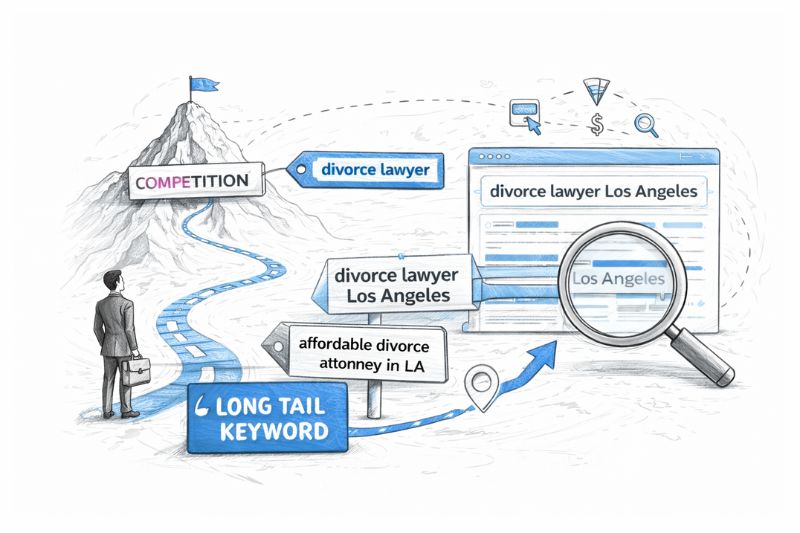
Long-tail keywords are simply longer, more specific search phrases.
For example, “divorce lawyer Los Angeles” is already a bottom-of-funnel keyword with strong intent. But it is also highly competitive.
A longer-tail version might be something like:
- high net worth divorce lawyer Los Angeles
- executive divorce attorney Dallas
- divorce lawyer free consultation Seattle
These phrases are more specific, and because of that, they usually have less competition. Fewer firms are targeting them directly, which makes them easier to rank for.
That is the main idea.
You focus some effort on the main keyword, but you put most of your early work into these more specific opportunities. That way, you can start getting traffic, leads, and validation before it takes years to compete for the most difficult phrases.
Why Long-Tail Keywords Can Produce Results Faster
The biggest advantage of long-tail SEO is that it helps you shorten the path to visibility.
With broad keywords, you are often trying to outrank firms with much stronger sites, better backlink profiles, more reviews, and years of SEO history behind them.
With long-tail keywords, you are often stepping into search spaces where:
- The competition is lighter
- The intent is still strong
- A dedicated page can rank with far less authority
- The visitors are often highly qualified
That last point matters a lot.
Some long-tail keywords are not just easier to rank for. They also attract better cases.
For example, a keyword like “high net worth divorce lawyer Los Angeles” may only have a limited number of searches per month, but the people searching for it may be much more valuable to a family law firm than someone searching more broadly.
Want to see what this looks like for your firm?
We’ll map out 3–5 long-tail keyword opportunities specific to your market that you could realistically rank for in the next 60–90 days.
Request your keyword snapshot.
A Practical Example: Broad Keywords vs. Long-Tail Keywords
Let’s look at the difference between a broad keyword and a more specific one.
Take a keyword like “Los Angeles divorce lawyer.” According to SEO tools, this kind of term can have a significant ranking difficulty and require dozens of referring domains just to have a chance of reaching the top 10. And top 10 is not even the same as ranking in the top three, which is where most of the clicks go.
If high-quality backlinks cost a few hundred dollars each, even a rough estimate can put the cost of competing at tens of thousands of dollars. In a market like Los Angeles, it is realistic to think the real investment required could climb far beyond that.
Now compare that to a keyword like “high net worth divorce lawyer Los Angeles.”
That phrase may only get a few dozen searches a month, but it is far less competitive. It also attracts a higher-value audience. And if you create a dedicated page for that exact topic, you may have a real chance of ranking much sooner.
That is the difference.
The broad keyword might eventually be worth millions in potential revenue if you rank for it. But the long-tail version gives you a more realistic entry point.
The Importance of Dedicated Landing Pages

One of the most important ideas here is this: if you want to rank for a long-tail keyword, you usually need a dedicated landing page for it.
You cannot expect one generic family law page to rank for every variation of every search. The firms that rank well for specific keywords usually have specific pages built around those topics.
If a firm is ranking for “high net worth divorce lawyer,” there is a good chance they have a dedicated high net worth divorce page.
That page does not need to be overly complex. In many cases, it might be around 800 to 900 words, clearly focused on the topic, properly optimized, and supported by a handful of relevant backlinks or even none at all.
That is a very different level of effort compared with trying to rank a homepage for a major city-wide keyword.
In some cases, pages with very little authority and no direct links can still pick up traffic if the keyword is specific enough and the page is relevant enough.
That is why this works.
Why This Is a Numbers Game
Not every long-tail page you create will rank.
Some keywords will turn out to be more competitive than expected. Some pages may need more authority, better optimization, or more time. That is normal.
But if you create 10, 20, or even 50 long-tail pages with decent keyword research behind them, the odds go up significantly that some of them will start pulling in traffic and cases.
This is where SEO starts to feel real.
Instead of waiting for one extremely difficult keyword to move, you create multiple opportunities across different topics, services, and locations. Some pages may do very little. Others may quietly become lead generators.
Long-Tail Keyword Ideas for Family Law Firms
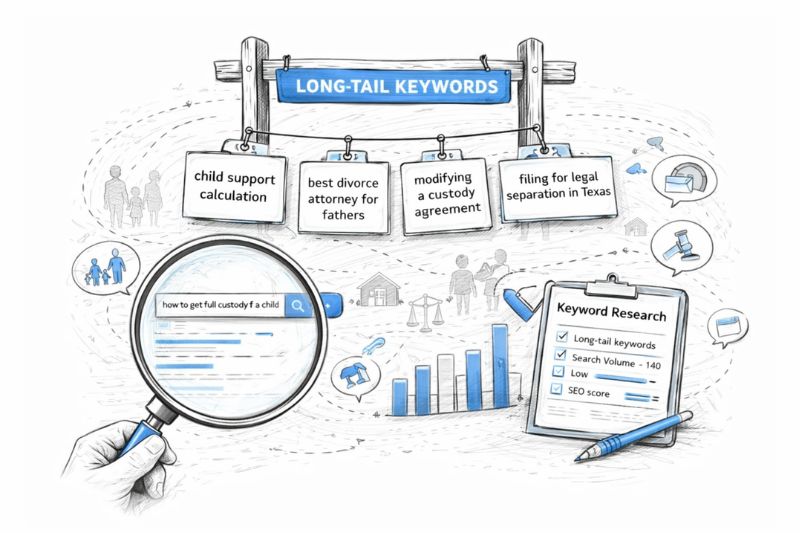
Here are several types of long-tail keywords worth considering for a family law practice.
High Net Worth Divorce Keywords
A phrase like “high net worth divorce lawyer” is a strong example of a long-tail keyword with high-value case potential.
These searches may be lower in volume, but the client value can be much higher. Someone searching for a lawyer for a high-net-worth divorce is often looking for specialized guidance in a more financially significant case.
Always add your city to these phrases.
So instead of just targeting “high net worth divorce lawyer,” aim for:
- high net worth divorce lawyer Seattle
- high net worth divorce lawyer Dallas
- high net worth divorce lawyer Los Angeles
This helps you compete locally rather than nationally, and it aligns much better with how most law firms actually serve clients.
Prenup Lawyer Keywords
Another useful keyword category is prenup-related searches.
Phrases like “prenup lawyer” or “prenuptial agreement attorney” can be valuable because the clients searching for them may have more assets to protect and may be looking for a more serious legal service.
Again, add the city modifier whenever possible.
Examples:
- prenup lawyer Dallas
- prenuptial agreement attorney Seattle
- prenup lawyer Los Angeles
Executive and Business Owner Divorce Keywords
These are especially attractive for firms that want to target higher-value cases.
Examples include:
- executive divorce lawyer
- executive divorce attorney
- business owner divorce lawyer
- company owner divorce lawyer
Divorce cases involving executives, founders, or business owners can be more complex and nuanced, which makes the search intent behind these terms especially valuable.
If your firm handles those types of cases, dedicated pages for them can make a lot of sense.
Free Consultation Keywords
If your firm offers free consultations and that model works well for you, then it may be worth creating a page around that offer.
Examples:
- divorce lawyer free consultation plus city
- family lawyer free consultation plus city
There is a tradeoff here. Free consultation searches can attract people who are not serious or who are only looking for free advice. But if your consultation process converts well, this type of page can bring in meaningful leads.
If it already works as part of your intake strategy, it is worth targeting.
Divorce Lawyer for Men and Divorce Lawyer for Women
This is another category that often performs better than many firms expect.
People do search for:
- divorce lawyer for men
- divorce lawyer for women
And they often search for those terms with a location attached.
If you serve those audiences and can create relevant, thoughtful pages around those needs, this can be another useful long-tail opportunity.
Affordable Family Lawyer Keywords
If affordability is part of your positioning, then it makes sense to target it directly.
A keyword like “affordable family lawyer” can be very relevant if that is genuinely part of your value proposition.
You do not want to target this keyword unless it matches your brand and offer. But if it does, it should have a dedicated page.
Always Add Local Modifiers
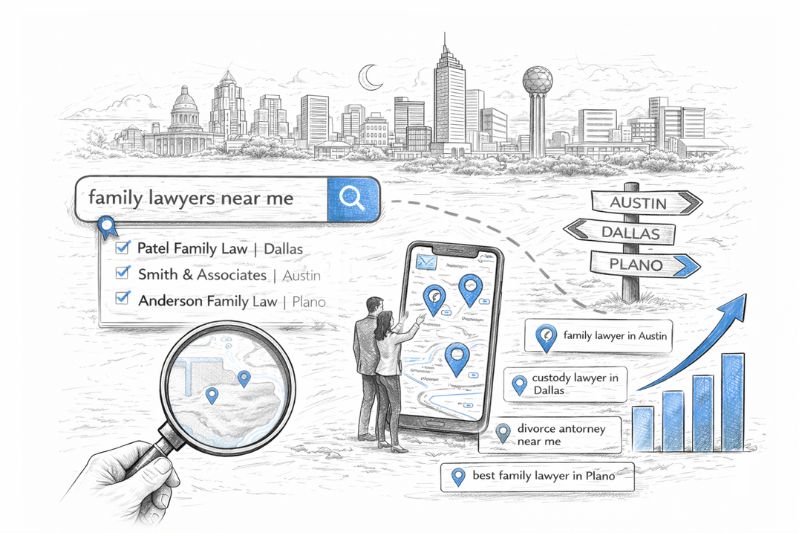
One of the most important takeaways is this: always add your city.
If you target a keyword without a location, you are often competing nationally. That is harder, and it is usually less relevant to the actual market you serve.
When you add your city, you are doing two things:
- You make it easier for Google to understand your local relevance
- You align the page with the audience most likely to become a client
If your firm serves Seattle, Dallas, Orlando, or Los Angeles, then use that location consistently in your keyword targeting.
Local SEO is almost always the smarter play for a family law practice.
Go Beyond the Main City and Target Sub-Locations
Another powerful long-tail strategy is to target smaller areas within your broader market.
Instead of only trying to rank for your main city, you can also create pages for:
- suburbs
- boroughs
- neighborhoods
- nearby cities you serve
- named districts or local areas people commonly search for
For example, in a market like Los Angeles, someone may search for:
- Beverly Hills divorce lawyer
- Santa Monica divorce attorney
In New York, someone may search for:
- Manhattan divorce lawyer
These kinds of searches can be less competitive than the main city keyword, while still bringing in highly relevant prospects.
If you serve people in those areas, create pages for them.
Make Those Location Pages Unique
There is one important caveat.
You cannot just copy and paste the same content from one city page to another.
Those pages need to be meaningfully different. They do not have to be completely rewritten from scratch, but they should be unique enough to make sense to users and to avoid looking thin or duplicated in Google’s eyes.
As a first step, you can rework the structure and wording of your main location page and then gradually improve it over time with more localized details, references, examples, FAQs, and testimonials.
The key is to make the page useful and relevant to that area.
Build Service-Specific Landing Pages

Family law covers a lot of different services.
That means you should not stop at one general family law page. Instead, think through the different service types you offer and create dedicated landing pages for each one.
Examples include:
- divorce law
- prenup law
- child custody
- child support
- alimony
- visitation
- property division
- postnuptial agreements
If you are in Los Angeles and offer child custody representation, then a page built around “Los Angeles child custody lawyer” makes perfect sense.
That page should focus specifically on child custody. It can include:
- what the service involves
- who handles it at your firm
- relevant FAQs
- client testimonials related to custody cases
- a clear CTA
It does not need to be a full-length blog post. It just needs to be a solid, focused service page.
When you combine service type plus location, you unlock a large number of long-tail keyword opportunities.
Use Blog Content to Answer Common Questions
Another excellent long-tail SEO strategy is to answer the questions people already ask your firm.
Take 10 minutes and write down the most common questions people ask:
- on calls
- during consultations
- through your intake team
- through attorneys at the firm
Then turn those questions into blog articles.
This works because people search in questions all the time. And when they find a clear, helpful answer on your site, they start building trust with your brand.
How Long Should These Articles Be?
A good benchmark is around 1,000 words, but that is not a rule.
If a question can be answered well in 300 words, answer it in 300 words. Do not drag it out unnecessarily. People do not want an essay when they are looking for a direct answer.
The goal is not to hit a word count. The goal is to answer the question thoroughly and clearly.
Add Location to the Question
Whenever possible, add your location to the question keyword.
For example:
- How much does a divorce lawyer cost in Texas
- How much does a divorce lawyer cost in Dallas
- How much does a divorce lawyer cost in Orlando
Even if the answer is broadly similar across locations, people often want to know how it applies in their area. They do not always assume the answer in one place is the same as the answer where they live.
That local modifier can make the article more relevant and more rankable.
Why FAQ Content Converts
Question-based blog posts do more than attract traffic.
They also build trust.
If someone finds your article, reads a clear answer, and feels like you understand their situation, you are no longer just another law firm. You are now the firm that helped them.
That creates a natural opportunity for conversion.
Inside those articles, include a call to action. Invite the reader to get in touch. Introduce the attorney. Add a photo. Add contact information. Make the next step obvious.
If they got value from the article, contacting your firm becomes the logical next move.
Even Blog Articles Can Rank Without Huge Authority

One of the encouraging things about this strategy is that not every successful page needs a huge backlink profile or a powerhouse domain.
Even in competitive spaces, there are blog articles ranking with moderate authority and little to no direct backlinks to that specific page.
That does not mean ranking is effortless. It still takes good research, strong writing, and a useful page.
But it does mean there is room to compete, especially if you choose your topics carefully and focus on questions and keyword variations that larger firms are ignoring.
The Real Takeaway
If you want the fastest path to SEO results for a family law practice, do not rely only on broad, ultra-competitive keywords.
Go after them in the background, yes.
But put most of your energy into long-tail opportunities that can actually move sooner:
- high-value niche case types
- service-specific pages
- city and suburb pages
- FAQ blog posts
- location-modified question keywords
This approach helps you start getting traffic earlier, proving ROI sooner, and generating cases while the broader SEO strategy matures.
SEO does not have to be all or nothing.
You do not need to wait years before it starts making sense. With the right structure and the right page strategy, you can start building momentum much faster than most firms expect.
Conclusion
For family law firms, the biggest SEO wins often do not start with the biggest keywords. They start with the smartest ones.
If your competitors are far ahead, that is not a reason to walk away from SEO. It is a reason to get more strategic. Long-tail keywords give you a practical path to rankings, traffic, and qualified leads without needing to beat the biggest firms head-on from day one.
Create dedicated landing pages. Target specific services. Add your city and sub-locations. Answer the real questions your prospects are asking. Do that consistently, and SEO can start producing results much sooner than most firms think.
Not sure if SEO is worth it in your market?
We’ll take a quick look and tell you whether there are realistic opportunities to get traction. If it’s not a fit, we’ll say so.