

If you run a family law practice, you have probably asked yourself whether writing blog articles is really worth your time. After all, time is your most limited resource. Between managing cases, clients, and operations, blogging can feel like a low priority.
The reality is this: for most law firms, blogging is one of the highest-leverage activities you can invest in. When done correctly, it becomes a consistent, compounding source of leads, builds long-term trust with potential clients, and significantly increases the value of your practice.
See who’s winning Google & AI search in your city
I or my colleague will record a free 3–7 minute personalised video showing who ranks #1 for family law in your market — and roughly how many consultations that position earns them every month.
In this article, we will walk through exactly why blogging works for family law firms, how it drives real case revenue, and the step-by-step system you can use to make it work for you.
Why Blogging Matters for Family Law Firms
Most law firms rely heavily on referrals or paid ads. While those channels can work, they are not always consistent or scalable. Blogging, on the other hand, creates a steady pipeline of potential clients coming from Google and AI-driven search.
It also increases the long-term value of your firm. If your practice consistently generates leads each month through content, it becomes far more attractive to a potential buyer. Many firms struggle with this because their client acquisition depends entirely on the founder. If that person steps away, the pipeline disappears.
Blogging solves that problem by building a system that works independently of any one individual.
The Two Ways People Find Lawyers on Google
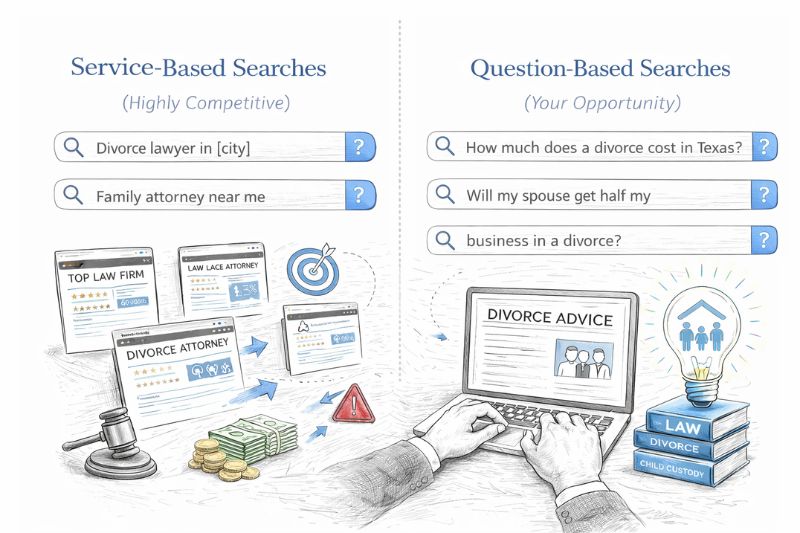
There are two primary ways potential clients search for legal help online.
Service-Based Searches
These are high-intent searches like “divorce lawyer in Orlando.” While they are valuable, they are also extremely competitive. Every law firm is trying to rank for these keywords, which makes them expensive and difficult to win.
You still need service pages targeting these terms, but relying on them alone limits your growth.
Question-Based Searches
This is where blogging becomes powerful.
People dealing with family law issues often prefer privacy. They are less likely to ask friends for recommendations and more likely to search online for answers.
They ask questions like:
- How much does a divorce cost in Texas
- Will my spouse get 50 percent of my business in a divorce
- How do I file for divorce
When you create blog posts that answer these questions thoroughly, you meet potential clients at the exact moment they are looking for guidance.
By educating them, you build trust. And when they are ready to hire a lawyer, you are the first person they think of.
The Three Core Benefits of Blogging
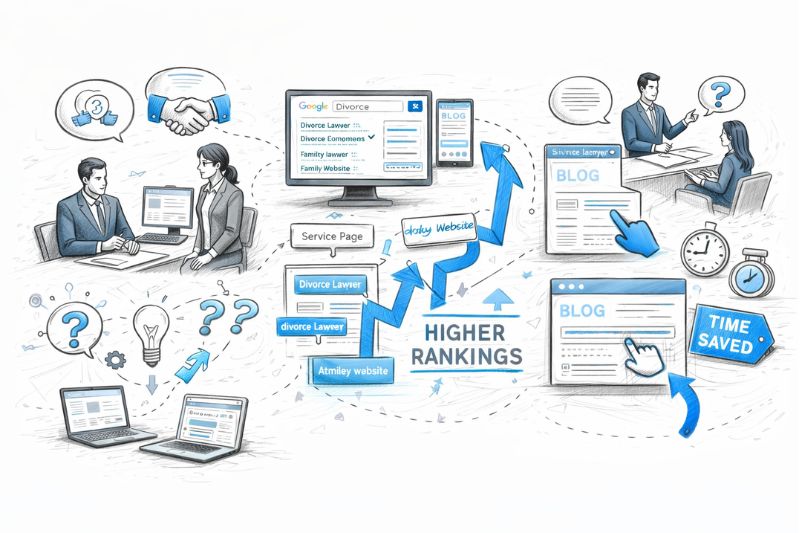
Blogging is not just about traffic. It serves three critical functions for your law firm.
1. Building Trust With Potential Clients
When someone finds your article and it answers their question clearly, you immediately position yourself as an authority. No competitor has that same level of trust unless they have also created valuable content.
2. Improving Your Search Rankings
Blog articles support your main service pages.
When you write multiple articles around a topic like divorce and link them to your main service page, you strengthen that page’s authority. This makes it easier to rank for competitive keywords like “divorce lawyer in your city.”
At the same time, your blog posts themselves can rank and bring in traffic independently.
3. Educating and Pre-Qualifying Clients
Once you have written an article, you can reuse it. Instead of answering the same questions repeatedly, you can send clients a link to your content.
This saves time and ensures consistent, high-quality explanations.
The Simple Math Behind Blog-Driven Revenue

Let’s break down the numbers using conservative estimates.
On average, one blog article generates about 100 visitors per year. Many articles perform far better, but this is a safe baseline.
If 200 visitors turn into one client, that is a 0.5 percent conversion rate. For a family law firm, a single client can be worth around $10,000 in lifetime value.
That means one article can generate approximately $5,000 per year.
Now scale that.
If you publish five articles per month, you will have 60 articles after one year. That can translate into around 30 new clients annually.
That is roughly $300,000 in additional case value per year from blogging alone.
And it compounds.
After five years, you could have 300 articles working for you, generating traffic and leads consistently.
Not every article will perform equally, but even with conservative assumptions, the upside is significant.
Your 3-Step Blogging System

If you are getting started, you do not need a complicated process. Focus on these three core steps.
Step 1: Find the Right Topics
Start with the questions your clients already ask you. These are proven topics with real demand.
You can also use keyword research tools to identify additional opportunities. Look for specific, question-based queries related to your practice areas.
Long-tail keywords are especially valuable because they are easier to rank for and often indicate strong intent.
Step 2: Write High-Quality Content
Your goal is simple. Answer the question better than anyone else.
Be clear, thorough, and practical. Avoid fluff and focus on providing real value. The more helpful your content is, the more trust you build.
Step 3: Keep Your Content Updated
Once published, your articles can continue generating traffic for years. All you need to do is review them periodically and update any outdated information.
Even small updates can help maintain rankings and relevance.
Advanced SEO Strategies to Maximize Results
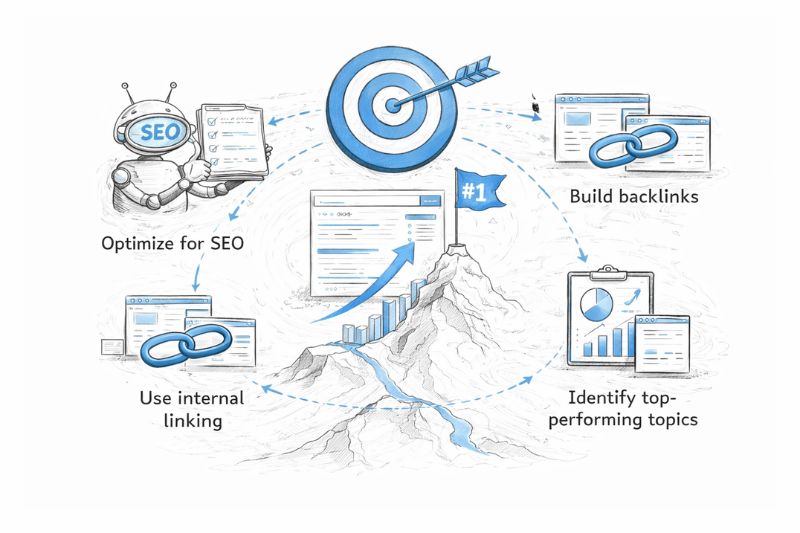
Once you have the basics in place, you can take things further.
Optimize Your Articles
Well-optimized content performs better in both Google and AI search results. This involves using the right keywords naturally and structuring your content properly.
Build Internal Links
Link related articles together and connect them to your main service pages. This strengthens your site structure and improves rankings.
Earn Backlinks for High-Value Content
Some articles are more valuable than others, especially those focused on costs or high-intent topics.
For these, you should invest in acquiring backlinks from other websites. This can significantly boost rankings and visibility.
Avoid the Common AI Content Trap
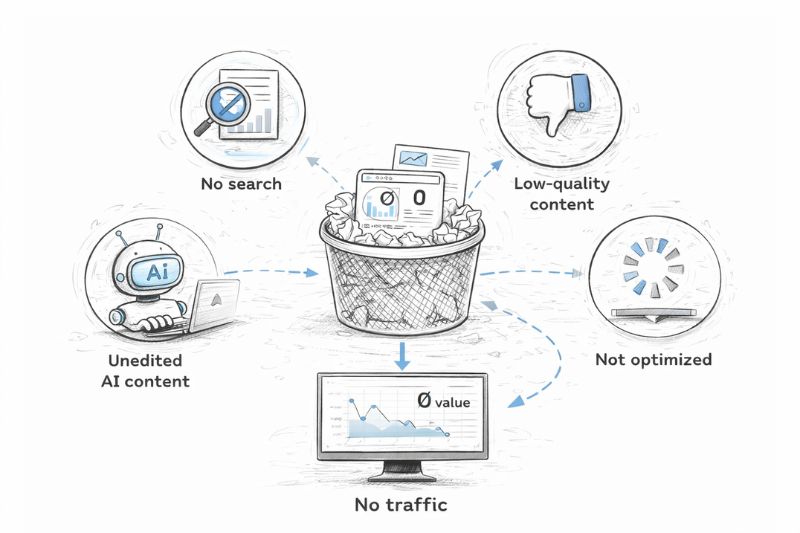
AI can be a useful tool, but it must be used carefully.
Many websites publish large volumes of low-quality AI-generated content that does not truly answer user questions. These articles often fail to rank or lose rankings over time.
If your content is not useful, optimized, or aligned with what people are actually searching for, it will not generate traffic or clients.
Quality always wins over quantity.
Conclusion
Blogging is one of the most effective long-term strategies for growing a family law practice. It builds trust, improves your search visibility, and creates a steady flow of qualified leads.
The key is consistency. Each article you publish becomes a long-term asset that continues working for your firm year after year.
If you commit to the process, the results compound in a way that few other marketing strategies can match.
Ready to Turn Content Into Clients
If you want to implement this strategy but do not have the time or internal resources, we can help.
At Batlinks, we specialize in SEO and content strategies that generate real case growth for law firms. From keyword research to content production and optimization, we handle the entire process.
If you would like to see how much traffic and how many cases your firm could generate from Google and AI, reach out to us today. We will walk you through the opportunity and show you exactly what is possible for your practice.