

AI search engines are changing how potential clients discover law firms online, but most firms still have no idea how much traffic AI platforms are actually sending to their websites. If you are trying to understand whether ChatGPT and other AI tools are generating leads for your firm, proper tracking is the first step.
In this guide, we’ll walk through exactly how to measure AI leads for lawyers using Google Analytics and how to use that data to improve your visibility in AI search.
See who’s winning Google & AI search in your city
I or my colleague will record a free 3–7 minute personalised video showing who ranks #1 for family law in your market — and roughly how many consultations that position earns them every month.
Key Takeaways
- Law firms can track AI traffic sources like ChatGPT directly inside Google Analytics using custom filters and reports.
- AI traffic is still small compared to Google search traffic, but it is growing rapidly and firms that track it now will have an advantage later.
Why Tracking AI Leads Matters for Law Firms

There is a lot of hype around AI right now, and many law firms are wondering whether AI search engines are already driving meaningful traffic and leads.
The reality is that Google still dominates local search for law firms.
One example showed a law firm receiving more than 204,000 visitors from Google over the last 12 months, while only getting around 300 visitors from AI search engines. That means AI represented just 0.3% of total traffic.
Another law firm received 60,000 organic visitors from Google and only 705 visitors from AI search engines, which amounted to roughly 1.32% of total traffic.
Even though the percentages are still small, the growth trend is significant.
AI usage continues increasing rapidly. ChatGPT alone reportedly reached hundreds of millions of weekly active users, and generative AI platforms are becoming a larger part of how people search for information online.
For law firms, this creates an important opportunity.
Firms that begin tracking and optimizing for AI traffic today will be in a stronger position as AI search adoption grows.
Why Google Still Dominates Legal Search
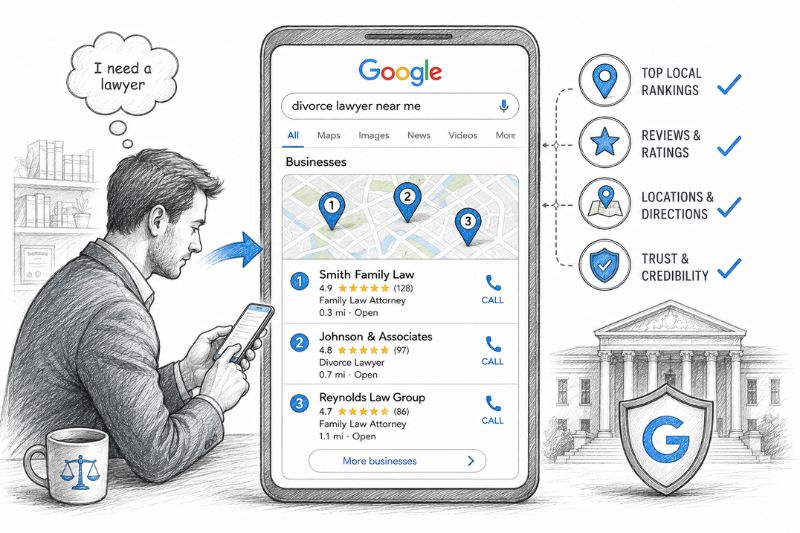
Most people searching for legal services still use Google in a very traditional way.
They search terms like:
- “divorce lawyer near me”
- “family lawyer near me”
- “personal injury lawyer near me”
Users are heavily conditioned to trust Google’s map pack results because they immediately see reviews, locations, ratings, and top-ranked firms.
That behavior has not disappeared.
However, AI search is beginning to impact informational searches, especially top-of-funnel content queries.
For example, when someone asks a legal question through ChatGPT or another AI assistant, the AI often provides a direct answer without requiring the user to visit a website.
This changes how content marketing works.
Instead of only trying to rank in traditional search results, law firms now also need visibility inside AI-generated answers and citations.
How to Measure AI Leads for Lawyers in Google Analytics
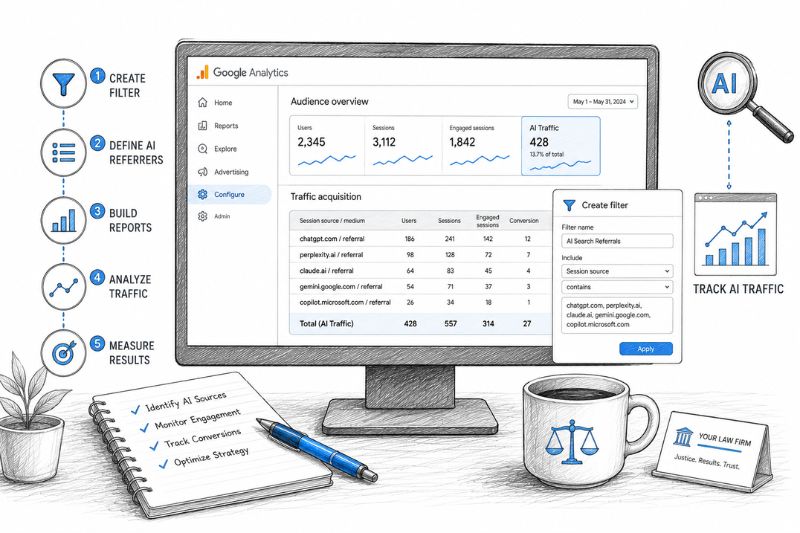
The best way to understand whether AI search engines are sending traffic to your law firm website is to create dedicated filters and reports inside Google Analytics.
Before starting, make sure Google Analytics is already installed correctly on your website.
Once Analytics is configured, follow these steps.
Step 1: Open the Traffic Acquisition Report
Inside Google Analytics:
- Click Reports
- Open Business Objectives
- Select Generate Leads
- Click Traffic Acquisition
This report shows where your website traffic is coming from.
Step 2: Expand the Date Range
By default, Google Analytics often shows only the last 28 days.
For AI traffic analysis, it is better to use a much larger timeframe.
Set the date range to:
- Last 12 months
This gives you a better understanding of long-term AI traffic growth patterns.
Make a note of your total website sessions before applying any filters.
For example, one client example showed nearly 350,000 total sessions over a 12-month period.
Step 3: Add an AI Traffic Filter
Now it is time to isolate traffic from AI search engines.
Inside the report:
- Click Add Filter
- Under dimension, search for:
- Session source / medium
- Choose:
- Matches partial regex
Next, paste in a regex filter containing AI traffic sources.
This allows Google Analytics to isolate visits coming from platforms like:
- ChatGPT
- Perplexity
- Claude
- Gemini
- Bing AI
- Other AI assistants
Once the filter is applied, you will see exactly how many visitors came from AI search engines.
In many cases today, the numbers are still relatively small compared to Google organic traffic, but the growth trend is what matters most.
Step 4: Change the Primary Channel Group
To make the data easier to understand:
- Change the primary dimension from:
- Session primary channel group
- To:
- Session source / medium
This gives a clearer breakdown of which AI platforms are sending traffic.
Instead of grouped channel data, you can see individual referral sources from AI tools.
Why AI Traffic Is Still Small for Law Firms
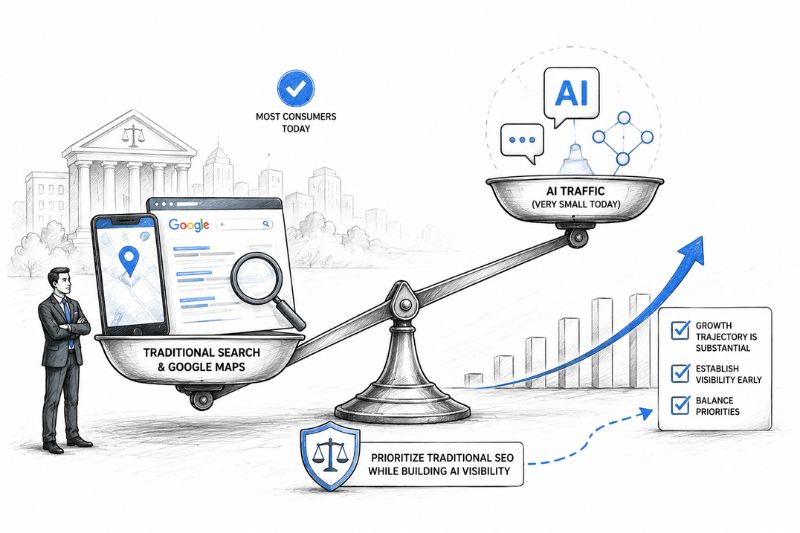
Right now, AI traffic for most local businesses remains a very small percentage of overall traffic.
That is especially true in legal search.
Most consumers still rely on Google Maps and traditional search results when looking for legal representation.
But that does not mean AI should be ignored.
The growth trajectory is substantial, and firms that establish visibility early may benefit significantly later.
The key is balancing priorities correctly.
Law firms should still prioritize traditional SEO and Google rankings while gradually building authority and visibility within AI search ecosystems.
How to Create a Permanent AI Traffic Report
If you do not want to manually recreate filters every time you check Analytics, you can save a custom AI traffic report.
Here is how.
Create a New Report
Inside Google Analytics:
- Go to Reports
- Click Library
- Select Create New Report
- Choose:
- Create Detail Report
Then select the existing:
- Traffic Acquisition template
Apply the Same AI Filter
Inside the custom report:
- Add the same session source filter
- Use the same regex settings
- Apply the filter
Then switch the dimension again to:
- Session source / medium
Now your report permanently displays AI traffic data.
Save and Name the Report
Give the report a simple name like:
- LLM Traffic
It is also helpful to include the month and year in the title because AI traffic sources evolve rapidly.
How to Add the Report to Your Main Navigation
To make the report easy to access later:
- Go to Business Objectives
- Click the three dots
- Select Edit Collection
- Drag the custom LLM report into your preferred section
- Save the changes
Now you can access AI traffic reporting in just a few clicks.
How Law Firms Can Use AI Traffic Data
Once you can accurately track AI traffic, you can start making smarter marketing decisions.
You can measure:
- Whether AI optimization efforts are working
- Which AI platforms send the most traffic
- How visibility changes over time
- Whether new content strategies improve AI exposure
This transforms AI SEO from guesswork into measurable performance marketing.
Use Annotations to Track SEO Changes
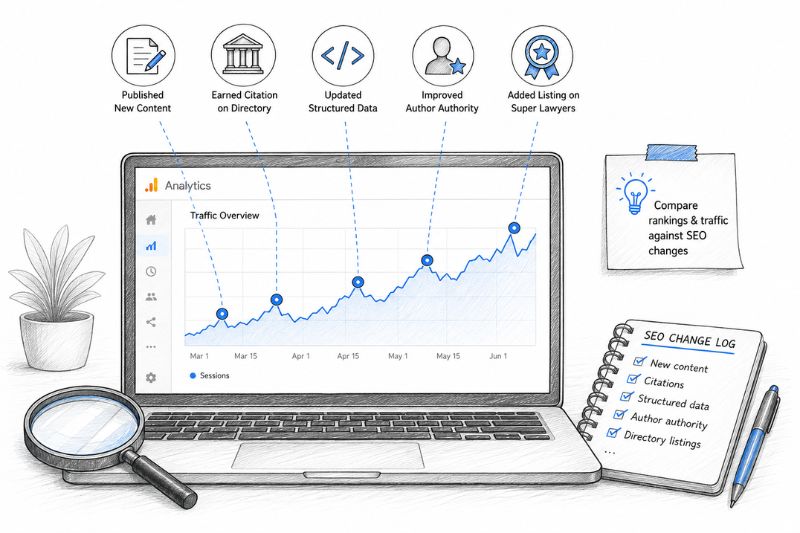
Another useful tactic is adding annotations inside Google Analytics.
Annotations allow you to record major SEO actions directly on your traffic graphs.
For example:
- Publishing new legal content
- Earning a citation on a legal directory
- Updating structured data
- Improving author authority
- Adding listings on sites like Super Lawyers
By documenting these changes, you can later compare ranking improvements and traffic increases against specific optimization activities.
This helps identify which AI SEO tactics are actually producing results.
The Future of AI Search for Law Firms
AI search is still in its early stages, especially for local legal services.
Google continues dominating high-intent legal searches, but AI platforms are steadily influencing informational discovery and content visibility.
Law firms that start measuring AI leads today will be far better positioned to adapt as search behavior evolves.
The firms that win in the next few years will likely be the ones that combine strong traditional SEO with early AI search optimization.
Ready to Improve Your Law Firm’s AI Visibility?
At Batlinks, we help law firms track, measure, and grow their visibility across both traditional search engines and emerging AI platforms.
If you want to understand how your firm is performing in AI search, where your competitors stand, and what actions can help you generate more qualified leads, contact our team today.
We’ll help you build an SEO strategy that prepares your law firm for the future of search.
FAQs:
How can lawyers track AI traffic to their website?
Lawyers can track AI traffic by creating custom filters inside Google Analytics. By filtering traffic sources from AI search engines and LLM platforms, law firms can measure how many visitors are arriving from AI-generated search experiences and monitor growth over time.
Is AI traffic important for law firms right now?
Yes, AI traffic is important for law firms, even though it is still a small percentage of total traffic today. AI search usage is growing rapidly, and firms that start tracking and optimizing early may gain a competitive advantage as AI search adoption increases.
What is the best way to measure AI leads for lawyers?
The best way to measure AI leads for lawyers is by combining Google Analytics tracking with lead attribution. This allows firms to identify which AI traffic sources are generating consultations, phone calls, and qualified legal inquiries.
Why should law firms optimize for AI search engines?
Law firms should optimize for AI search engines because AI-generated answers are influencing how users discover legal information online. Firms that improve their authority, content quality, and online citations may increase their chances of being referenced inside AI-generated responses.